Bishop Sean’s Farewell Interview: People Here Don’t Give Up
As he concluded his day-to-day ministry as bishop of the Dioceses of Northwestern Pennsylvania and Western New York, Presiding Bishop-elect Sean Rowe sat for a farewell interview with Jim Naughton of Canticle Communications.

JN: Are you finding it difficult to leave? Obviously you’re not leaving Erie physically, but you are detaching from a job you’ve had for a long time.
Bishop Sean: I find it extraordinarily difficult and challenging. As I’ve said to people over and over again, I have mixed feelings about leaving. This is a region of the country that I’ve lived in and served my whole life, and that I’ve come to love and to understand and appreciate deeply. And I’ve not ever had the sense that this is something that I would want to leave if I could, or go on to something better or different.
JN: But …
Bishop Sean: But being presiding bishop comes to me really as a call. And I’m in love with the region and with the people in it and with the congregations. I’ve come to know and love them. So I’m sad to leave. And there’s also excitement and anticipation on taking on this new role.
JN: What most excites you about taking on the new role?
Bishop Sean: The ability to take what I’ve learned from the people in this region and this place, and take that very practical learning and those sensibilities to the office of presiding bishop. I have learned a way of being from people who have been willing to try new things and experiment under difficult circumstances. And I can take those lessons to a church in which so many of our dioceses are in a very similar place. In different contexts, but in a very similar place.
JN: You’ve said that you’re excited to take what you learned in the region and carry it on. Can you talk a little bit about what you think you’ve learned?
Bishop Sean: I think there are a number of things that I’ve learned from being here. First is a kind of resilience. That word gets used a lot; I dare say it’s overused. But what it means to me in this context is the ability to both deal with and come to terms with reality as it currently exists, and to be able to continue on, to have hope for the future — to be able to do both of those things. I think in this region where industry has changed, jobs have shifted, focus has shifted, the economy has been a challenge for a very long time, balancing those two elements has been just a necessary part of living. So it’s either you have this resilience, or you just give up. And people here don’t give up.
The other thing I’ve learned is a kind of practicality. There’s a practical way of thinking. It’s fine to have a big idea, but there’s a practical sensibility that goes with it. So if you put out an idea, and even if it’s kind of far out there, if you have a practical way it can be implemented and it looks like it might work, people will say, “Okay, we’ll try it.” There’s a practicality.
And I think the other thing that I’ve learned is the value of directness and authenticity. Just being able to talk to people about how things really are. So there isn’t the need to sugarcoat. People here are just often able to express what they need to express and move on. I think that’s been a gift.
JN: Are there particular moments since you returned to the Diocese of Northwestern Pennsylvania as a new priest that you look back at and say, “Okay, these were the things that I keep going back to. These were my touchstone experiences”?
Bishop Sean: I became a rector and was a brand new priest at the age of 25. And I remember that time well as a time where I was able to both serve as a priest—in other words, bring my gifts to the table as a priest—but also have people teach me how to be a priest. I learned how to be part of a community, and I learned what the church could be from people who were willing to both receive the leadership of a priest and also to help form one at the same time. I go back to those formative years as critically important. And my first senior warden is coming to the investiture, Kaycee Reib.
My consecration and ordination as the bishop of the Diocese of Northwestern Pennsylvania in 2007 was, especially by today’s standards, a relatively simple liturgy in a college chapel with a very simple reception following, where the diocese was gathered. And I remember that as a really important day. It did not feel like, it was not, entirely about me. It was about the diocese gathering for the next chapter in the way a diocese like the Diocese of Northwestern Pennsylvania would gather, which is in a very simple way with food we enjoyed and people we enjoyed, and in a way that was ultimately simple and practical.
And I remember over 20 people from my seminary class were there and just remarked on the atmosphere, how it felt like a community.
And I think 2010, as we dealt with the sexual misconduct of one of my predecessors around children, was a very important time. There was a lot of pressure from a risk management standpoint to do what the church had always done, to continue on a trajectory of doing the best we could to manage our image publicly and to minimize our legal risk. But we took a different route.
The hard part about that was fighting against the grain of the risk managers and maybe dealing with what some of the expectations from the rest of the church. But internally, I had the support of key leadership to do that. People were interested in doing the right thing. And I will always be grateful not only for the small team of people that were around me to make those initial decisions to go forward and make it public, do the honest thing, be transparent, tell all, but the reaction of the vast majority of the diocese at the time, which was, “You did the right thing.”
It didn’t feel or seem extraordinary to anybody. It just felt like it was the right thing to do. I always come back to that, because I find it a remarkable piece of a culturally conservative region where people just know what it means, in the end, to do the thing that’s right, and just know the importance of doing the right thing. In other words, that’s what the church does, this is who we are. Clearly they had a bishop for almost 20 years that was doing other things, but when they knew about it, they did the right thing.
Another touchstone is when I went on to be the bishop of Bethlehem in 2014. That was an extraordinary move, and, again, people here just thought, “Well, that makes sense. Why don’t we try that? This will be an interesting experiment.”
It was a similar thing when we put together the partnership. It wasn’t necessarily something that was an easy process, but people realized some things are worth trying even if they don’t work. And so here we have two examples of different kinds of experimentation, and history will judge whether those were good things or not, but in any case, they helped us do what we needed to do, answer God’s call on a particular time and people. There was a willingness there. So I think as difficult as some of those decisions were, and not everybody was always happy all the time, those are times I go back to and think that in the end, people were willing to try something for the sake of the gospel.
JN: You have to some extent now a reputation as somebody who does experiments and somebody who works with organizational theory and organizational strategies, yet a lot of the work that you have to do is quite personal. It’s work you do one-on-one or in small groups. I’m wondering about those kind of conversations that people are maybe less aware of than the bigger experiments. To what extent has relational ability been central to your ministry?
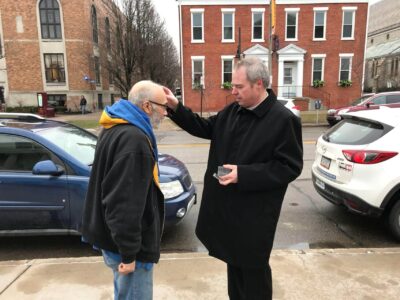
Bishop Sean: Well, the one-on-one, the personal relationships, the small groups, to me, form the basis of community. And there’s no way to do anything big or have any kind of big experiment or make any kind of big change without the key personal relationships. And frankly, it’s the personal relationships that are the real joy in it for me. When I was a parish priest, I used to tell people that for the first three years they shouldn’t pay me a salary. I should pay them, because it’s such a privilege to be part of people’s lives. I enjoyed it so much. You always have days where that isn’t the case, but I love being part of the small things, the celebrations, being there when people need us the most. I’ve been there in times of transition.
I felt that way as a bishop too. I can go into most of my congregations, I know the leadership. I know many of the people. For example, our diocesan summer camping program, I’ve been part of that for 25 years now. I’ve married many of these young people. I’ve buried a few of them over the years. I’ve been part of their ups and downs and their life transitions. One of the acolytes for my investiture was an acolyte at my diaconal ordination, my priestly ordination, my ordination to the episcopate. And now he’s in his early 30s and he asked if he could be an acolyte for this. And so, of course.
So those are the joys of it. The relationships that I’ve built in the community, the pastoral work that we get to do. It’s the work I love, and it is most of the work, really. Yes, right, we talk about big organizational change, and I’ve been involved in lots of governance work and lots of big things, but the real work really is the pastoral work and the work of being present to people. And the work, frankly, of spiritual development and my own work on my own spiritual life and walking along others in theirs. That’s what this is all about anyway, that’s the point of it all.
JN: So you will be handing this off. Other leaders will be carrying forward this work you’ve begun. If you were handing it to one person and they came and said, “So okay, what do I have here?” How would you describe it?
Bishop Sean: I would say that you have a treasure that’s no longer hidden in a field. That’s what I think. Here are people who have had a rough go of it over the last 30 or 40 years regionally, and the churches have been in that same position. And they decided to put their gifts and put their charisms to work for the sake of the gospel, and did it. And they’re a treasure. And I think there’s more to come forth here, and you’re in just the right place to continue to try something new and to let the people of this region teach you.
JN: Do you think folks in the two dioceses understand the extent to which they’ve been a model? Dioceses are lining up to figure out if this is the path for them. Do you think folks are aware of the gift that has been to the church?
Bishop Sean: I’m not sure. I’m not sure people are quite aware of the gift that they’ve given to the church. I talk about that quite a bit. I think, though, when you’re in the midst of an experiment or you’re in the midst of doing it, it’s very hard to see the ways in which it might be affecting a wider group of people, because at various points it feels difficult or it feels rocky. And so it’s hard to look around and see that other people are following the lead when it doesn’t feel like maybe we’ve quite achieved what we want to here.
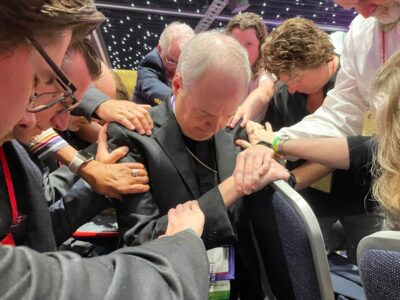
So no, I don’t think so, but also I think that is part of the way this region works. People here don’t do things to make statements or to be an example. They just do things because it seems like the right thing or the practical thing to do. So when I was elected bishop in 2007, people wondered, was the diocese trying to say something by electing a 32-year-old to be bishop of the diocese? I said, “That’s just not how people think.” I think a lot of people didn’t think about it until after, when people said, “Oh, this is a young bishop,” or “You’ve elected such a young bishop.” I think somebody said, “Oh yeah, I guess we did.”
There wasn’t this sense that, “Well, we have to make a statement. We’re trying to make some kind of statement.” It’s like, “Well, no, that seemed like the right thing.” And I think that’s a lot of what’s happened with this experiment in both dioceses, is people just think, “Well, we just did the next right thing.” I would hope that people come to understand what an influence they’ve had on the rest of the church and how much it’s meant to others around the church that we went first.
I hope that someday can be part of the narrative and that people can take that to heart.
JN: You, Carly and Lauren will continue to reside in Erie. What kind of relationship do you imagine yourself having with the partnership, especially the Diocese of Northwestern Pennsylvania, after your investiture? How do you think things will be the same, and how do you think they will be different?
Bishop Sean: I’ve thought a lot about this. I think some of it I’ll know as it unfolds. I think I will continue to be right here and invested in the region and cheering on the work that this diocese, that our partnership will continue to do in the near future and that our diocese will continue to do. I think key is, and I’m sort of stating the obvious here, that I won’t be the bishop. And so it’ll be up to others now to imagine a future. And what I’ll be able to do is pray alongside of that and hopefully be a good encourager. And I know how to do that, encourage from the sidelines. So I think that’s going to be different from me rather than being in the middle of it, coaching from the sidelines.
And it will also give me the opportunity to, I think, serve in ways that the next group of leadership would need me to serve or would invite me to serve. And I don’t know what that’s going to look like. It’s a good question. I don’t know how to be more articulate about that.
JN: Anything else you’d like to say?
Bishop Sean: Only that it is a privilege to be able to serve in a capacity like bishop in a place you grew up, around people who knew you when, and that have been part of a long-time growth and maturation process. I will always be grateful for the opportunity to have been able to stay home and serve people. And I hope to continue to do that, albeit in a different role.