Standing on Holy Ground: Diocesan Partnership Pilgrims Visit Alabama
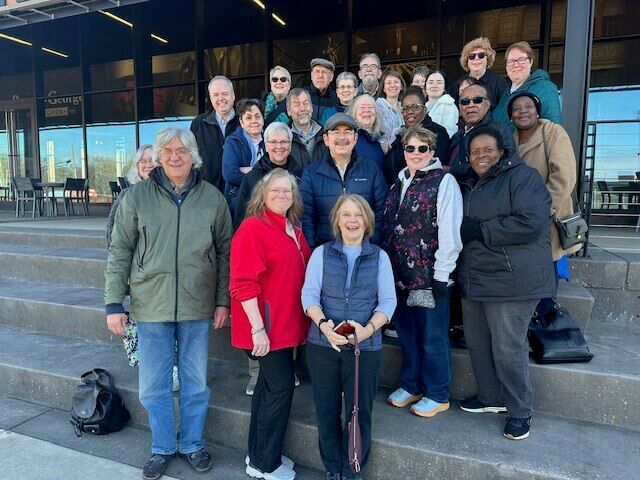
Last week, Bishop Sean and 22 people from the diocesan partnership traveled to Alabama to visit key sites from the Civil Rights Movement and learn about the history of racism and racial violence. Organizers hope the journey will become a regular pilgrimage for people from our dioceses.
The Rev. Kim Rossi of St. Stephen’s, Olean, who arranged the trip with the Rev. Ann Tillman of St. Matthias, East Aurora; the Rev. Adam Trambley of St. John’s, Sharon; and Sara Nesbitt of St. Mark’s, Erie, said that Bishop Sean’s 2023 visit to Alabama with the House of Bishops was the impetus for the journey. Over three days, the partnership group visited Selma, Montgomery and Hayneville, where Jonathan Daniels, an Episcopal seminarian, was shot dead while protecting a young girl named Ruby Sales from a sheriff’s deputy.
“It was a very reverent trip, as though at times you were standing on holy ground,” Rossi said. “I know of all of those things, but not to these depths. It gave us a far better picture of what really happened.”
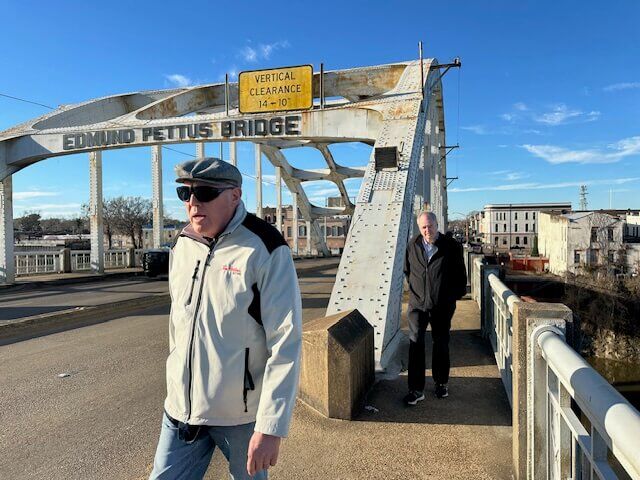
In Selma, the group walked over the Edmund Pettus Bridge, where Civil Rights marchers were beaten by law enforcement officers on Bloody Sunday, March 7, 1965. Afterward they rode by bus to Montgomery, following the route that peaceful protesters marched two weeks after Bloody Sunday under the protection of National Guard troops sent by President Lyndon Johnson.
The diocesan group’s tour guide was 12 years old in 1965 and recalled for the pilgrims how he had marched the last leg of that historic route into Montgomery and up to the Alabama State Capitol.
For the Rev. Mark Elliston, rector of Christ Church, Oil City, hearing the guide’s experience brought new force to last week’s lectionary gospel reading, in which Jesus calls his disciples to leave their lives and livelihoods to follow him.
“What price are we willing to pay for following Jesus?” he asked. “Are we willing to give up family, friends, jobs, liberty, life? On the pilgrimage we saw how far some people, like our guide, had to go. They did have to risk everything.”
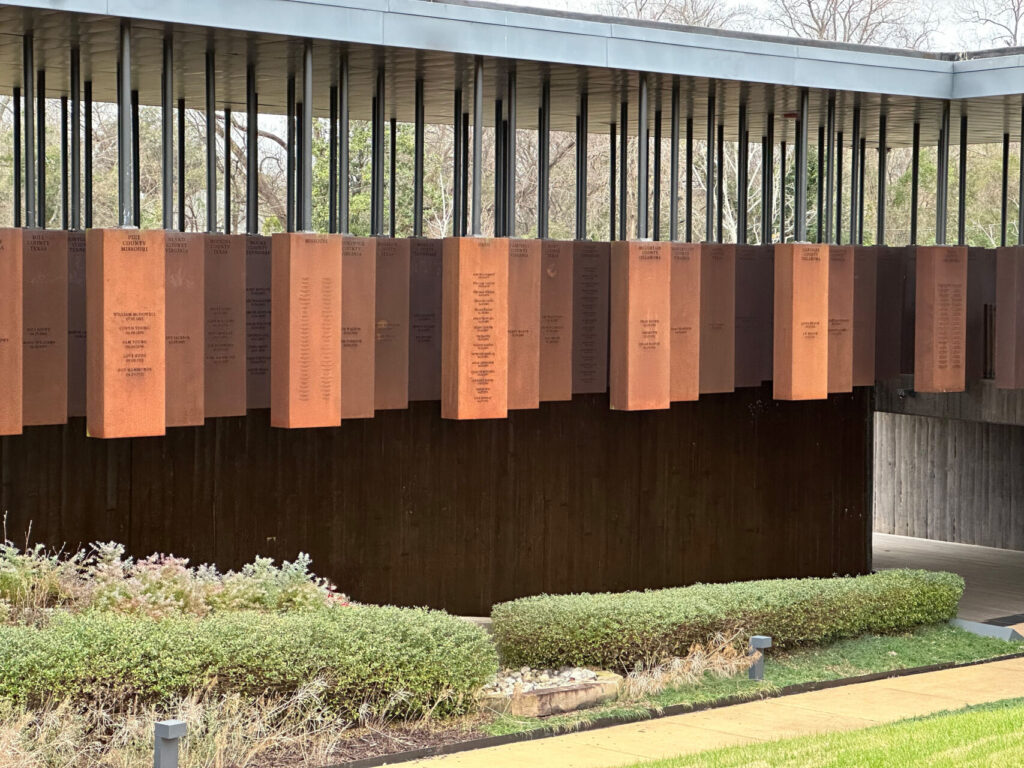
In Montgomery, pilgrims visited several museums, including the Equal Justice Initiative’s Legacy Museum, which traces the history of enslavement, Jim Crow, and mass incarceration, and the National Memorial for Peace and Justice, which remembers more than 4,400 Black people who were killed in racial terror lynchings in the United States between 1877 and 1950. Their names are engraved on more than 800 steel markers, one for each county in which lynchings took place.
The experience, Rossi said, made it impossible to think that racism is, or has been, only a Southern problem.
“We all have a part in this, we all have a history. It isn’t just that we can look at one part of the country and say–it’s their fault,” she said, recalling an incident from her own childhood in rural New York State in which a white teacher chastised her for writing a book report about Harriet Tubman and had the book removed from the school library.
“Don’t get involved in anything having to do with those people,” she recalls him telling her. “It’s dangerous.”
Elliston’s congregation has long been involved in a Venango County racial justice effort called Together We Can, which provides scholarships and sponsors local school programs. At the National Memorial for Peace and Justice, he was particularly moved by the monuments to children who were lynched, calling their deaths “true evil.”
“Jesus casts out demons in this week’s gospel, and that type of evil is what was encountered during the Civil Rights Movement — evil on that demonic level,” he said. “We are still dealing with the residual effects of that in healthcare, in the justice system. People have got to have a personal encounter with racism to see the impact it is still having in people’s lives to get it from their head to their heart.”
The group also visited two Episcopal churches in Montgomery—one historically white, built by the labor of enslaved people—and the other, Church of the Good Shepherd, a historically Black parish constructed in 1896 when a group of Black parishioners previously consigned to a slave gallery at a white church petitioned for a church of their own. At Good Shepherd, the congregation hosted a Eucharist led by the pilgrims on their last evening together.
“The worship service was intended to punctuate why we were there and serve as a confession to our role in allowing racism and discrimination to occur,” Rossi said. The liturgy included an ELCA litany titled “Confessing Racism: A Lament for the Church.”
“Confessions are empty promises without meaningful actions—actions that are grounded in prayer, education, and soul-searching repentance,” it reads. “…As we repent, let us not turn back to ideologies that promote white supremacy. We trust that God can make all things new.”
“The continuity of being in that space resonated with our worship, especially after having learned so much of the struggle for dignity and freedom,” Susan Woods, a leader of the partnership’s Commission to Dismantle Racism and Discrimination from Church of the Good Shepherd, Buffalo, said. “It was inspiring to renew our resolve to live the Gospel through continued justice-making.”
Rossi and other Commission leaders hope to organize a second pilgrimage to take place in 2025. Email her to learn more.